


The transition from a spark of imagination to a physical product held in a child’s hands is a journey of precision and artistic strategy. While the adult coloring book market has seen a massive surge, the demand for high-quality coloring book design for kids remains a cornerstone of the publishing industry. For authors, educators, and entrepreneurs, the challenge lies not just in having a great theme, but in translating that theme into a cohesive, engaging, and “publish-ready” format.
Creating a successful book requires more than just drawing outlines; it demands an understanding of cognitive development, line weight, and print specifications. This guide explores the professional roadmap for transforming raw creative concepts into a polished, market-competitive coloring book.
From Abstract Concept to Concrete Theme
Every professional project begins with a foundational “Why.” Before a single line is drawn, an author must define the book’s purpose. Is it an educational tool for preschoolers to learn the alphabet? Or is it a complex activity book designed to keep older children engaged during long travels?
Defining the target age group is the most critical step in early kids book design. For toddlers, shapes must be bold, large, and simple to accommodate developing motor skills. For older children, the complexity can increase, incorporating intricate backgrounds and storytelling elements. Establishing a “Style Guide” early on—deciding on character proportions, line thickness, and thematic consistency—ensures that the final product feels like a unified piece of art rather than a collection of random sketches.
Strategic Planning of the Book Structure
A common mistake in independent publishing is treating a coloring book as a random assortment of pages. Professional coloring book design involves careful “storyboarding,” even if the book doesn’t have a linear narrative.
- The Flow: Start with simpler designs to build the child’s confidence, gradually moving toward more detailed illustrations.
- The Layout: Consider “bleed” and “margins.” In the world of print-on-demand (like Amazon KDP), ensuring that the art doesn’t get cut off in the gutter (the middle fold) is essential.
- Single-Sided vs. Double-Sided: High-end coloring books often feature single-sided printing to prevent “bleed-through” from markers or watercolors, adding perceived value for the consumer.
Integrating educational elements, such as “trace the word” sections or simple puzzles, can also transform a standard coloring book into a multi-functional activity book design, broadening its market appeal to parents and teachers.
Creating Kid-Friendly Illustrations
The heart of the book lies in the characters and environments. Coloring book design for children’s requires a specific aesthetic that balances “cuteness” with “clarity.” Characters should have expressive features and clear silhouettes.
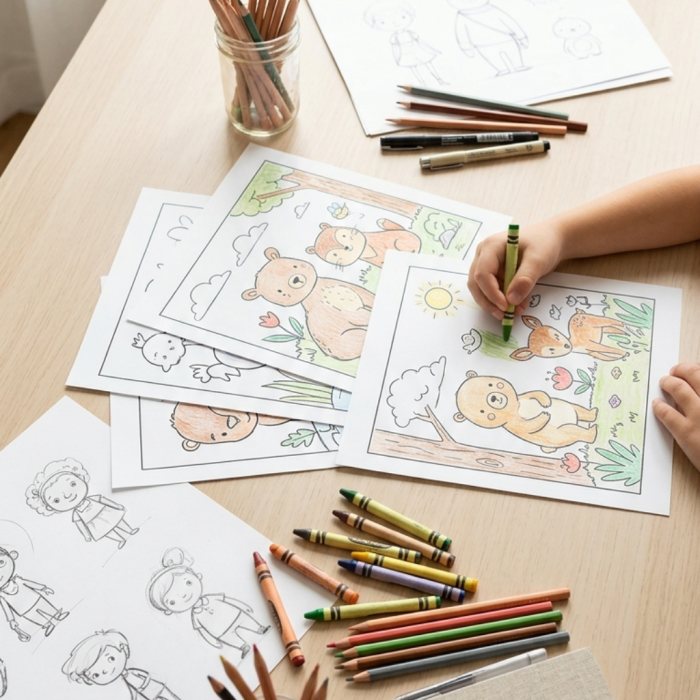
When developing custom coloring book illustration, the artist must leave enough “white space.” If a drawing is too cluttered with detail, it leaves no room for the child to actually color, leading to frustration. The goal is to provide a framework that invites creativity rather than a finished piece of art that happens to be black and white. Using varied line weights—thicker for the main subject and thinner for background details—helps the child identify the primary focus of the page immediately.
The Critical Role of Professional Line Art
There is a significant technical difference between a “sketch” and “production-grade line art.” Professional studios utilize vector-based software or high-resolution raster tools to ensure that lines remain crisp and sharp at any size.
If lines are pixelated or “hairy,” the final print will look amateurish. High-quality coloring book design focuses on “closed paths.” This means ensuring there are no gaps in the outlines. Gaps can make digital coloring difficult for those using tablets and can make physical coloring feel “unfinished.” Clean, deliberate strokes are the hallmark of an expert designer and are what separate a best-seller from a hobbyist project.
Maintaining Consistency and Visual Harmony
Consistency builds trust with the reader. If a character appears on page five and again on page twenty, their features, clothing, and scale must remain identical. This level of detail is where many DIY projects falter.
Beyond character consistency, the “visual weight” of each page should be balanced. If one page is extremely dense with forest details and the next is a single floating apple, the book feels disjointed. A professional approach involves auditing the entire manuscript to ensure a rhythmic variety that keeps the child engaged from the first page to the last.
Technical Preparation for Publishing
Once the artwork is complete, the “pre-press” phase begins. This is where the creative vision meets the hard reality of printing technology. Whether the goal is a physical book or printable coloring pages for a digital storefront, the files must be optimized.
- Resolution: All files should be at least 300 DPI (dots per inch) to avoid blurriness.
- Color Profile: For print, files are typically converted to CMYK or Grayscale to ensure the blacks are deep and the whites are pure.
- Format: Exporting as a “Print-Ready PDF” with embedded fonts and flattened layers is the industry standard.
For those looking to enter the digital market, creating “flattened” versions for tablets ensures that the digital “paint bucket” tools work correctly without leaking color across the entire screen.
Why Professional Design is a Business Necessity
In a saturated marketplace, the “cover” and the “interior quality” are the only things that prevent a customer from clicking away. A professional coloring book design does more than just look good; it functions correctly. It adheres to the specific margins required by global distributors and uses psychological cues to engage its target audience.
Working with an established name like Lumonova Studio allows creators to bypass the steep learning curve of publishing software and printing requirements. Outsourcing the technical aspects of line art and layout to experts ensures that the creator can focus on marketing and brand growth, knowing the product itself is of a professional standard.
Conclusion: Bringing Your Vision to Life
Turning a creative idea into a successful coloring book is a multi-layered process that blends art with engineering. By focusing on intentional concepts, clean line art, and rigorous technical standards, authors can create products that stand out in a crowded digital and physical marketplace.
Whether the project is a small-scale educational tool or a major commercial publishing venture, the quality of the design determines its longevity. For those ready to move from the sketching phase to a market-ready product, Lumonova Studio provides the expertise needed to navigate the complexities of children’s book illustration and professional formatting.
The world of children’s publishing is waiting for unique voices; ensuring your design is professional is the first step toward making your creative mark.