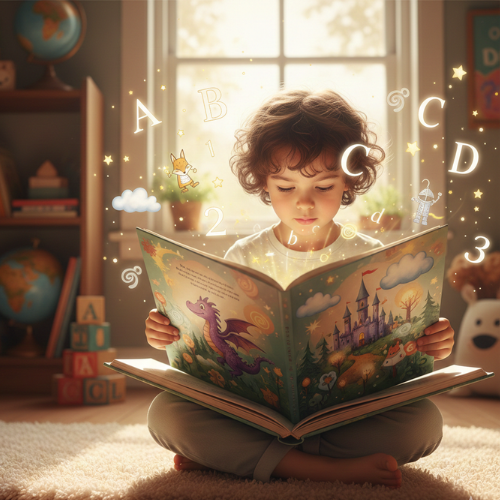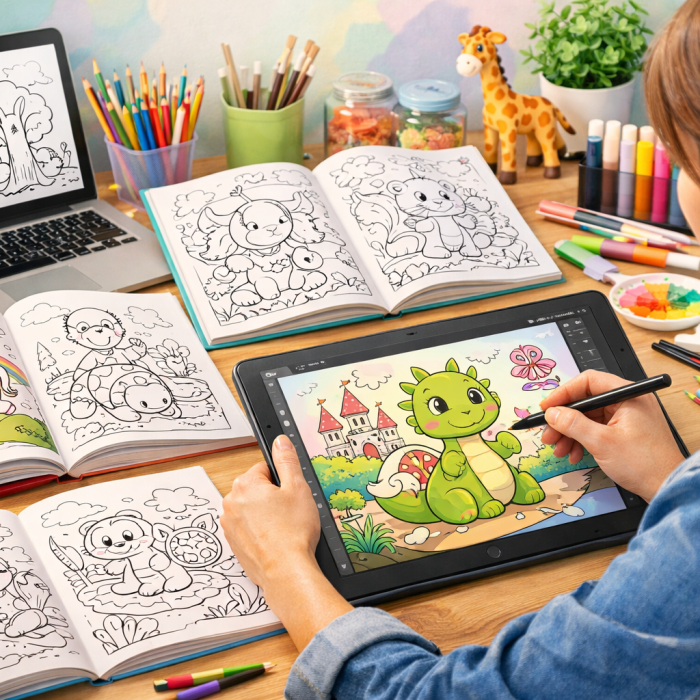



In the world of children’s publishing, there is a long-standing debate regarding which element carries the heavy lifting: the prose or the pictures. While a compelling narrative is essential, the visual component often serves as the true heart of the experience. For a child who has yet to master the nuances of language, the children’s book illustration is not merely a decoration—it is the primary gateway to understanding, empathy, and logic.
Before a toddler can decipher a single consonant, they are already expert decoders of visual data. They observe colors, expressions, and spatial relationships to make sense of the world. This is why, in many ways, the artwork in a picture book isn’t just supporting the text; it is doing the vital work of storytelling long before the words are read aloud.
Why Visual Storytelling Works Better for Young Minds
The human brain processes images approximately 60,000 times faster than text. For young children, whose cognitive faculties are still in high-development phases, this disparity is even more pronounced. Visual storytelling for children bypasses the complex mechanical hurdle of decoding phonics and moves straight to the emotional and conceptual core of a story.
When a child looks at a character’s slumped shoulders or a darkening sky in a painting, they immediately grasp feelings of sadness or impending danger. They don’t need the word “melancholy” to feel the weight of the moment. By providing these visual cues, an illustrator creates an immediate, intuitive connection that text-heavy media simply cannot replicate for an early-years audience.
How Children’s Book Illustration Shapes Imagination
Imagination is often misunderstood as the ability to dream up something from nothing. In reality, it is the ability to synthesize known visual elements into new, creative forms. High-quality children’s book artwork provides the building blocks for this process.
A skilled children’s book illustrator does more than just draw what is written; they expand the world. They add “Easter eggs” in the background, define the texture of a monster’s fur, and establish the lighting of a magical forest. These details serve as “imaginative scaffolding,” allowing children to enter a world that feels tangible and three-dimensional. This visual richness encourages kids to ask “what if?”—the fundamental question that sparks a lifelong love for creativity.
Can Children Understand Stories Without Illustrations?
While older children and adults rely on “theater of the mind,” younger audiences lack the lived experience to visualize complex scenarios without a reference point. If a story mentions a “bustling Victorian marketplace,” a child has no mental library to pull from.
Illustrated children’s books bridge this gap. They provide the necessary context that allows a child to follow a plot. Without these visuals, the narrative becomes a series of abstract sounds. Illustrations act as the “anchor” for the spoken word, ensuring that the listener and the reader are inhabiting the same mental space.
Expert Insight: In the absence of text, a child can still “read” a book by following the visual arc. In the absence of illustrations, a pre-literate child is effectively locked out of the story.
The Psychology Behind Picture-Based Learning
The “Picture Superiority Effect” suggests that concepts are much more likely to be remembered if they are presented as pictures rather than words. In early childhood education, this is a cornerstone of learning.
- Emotional Recognition: Illustrations help children identify and name emotions by observing facial expressions.
- Spatial Awareness: Seeing objects in relation to one another helps children understand concepts like “over,” “under,” “far,” and “near.”
- Pattern Recognition: Repeating visual motifs throughout a book helps develop the logic required for mathematical and scientific thinking later in life.
Professional studios, such as Lumonova Studio, understand that every brushstroke carries psychological weight. The choice of a soft pastel palette versus sharp, jagged lines can fundamentally change how a child perceives a character’s safety or threat levels.
What Makes a Great Children’s Book Illustrator?
Not all artwork is created equal. A great children’s book illustrator must be a co-author in every sense of the word. They must possess:
- Consistency: Keeping a character recognizable across 32 pages is harder than it looks but is vital for a child’s sense of continuity.
- Clarity: The artwork must be readable. Overly cluttered pages can overwhelm a young mind, while too much simplicity might fail to engage them.
- Subtext: The best illustrators add details that aren’t in the text. If the text says “The cat sat on the mat,” but the illustration shows the cat looking mischievously at a fishbowl, the story becomes infinitely more complex and engaging.
Lumonova Studio prides itself on this level of depth, ensuring that the picture book illustration process honors the intelligence of the young reader by providing layers of meaning within every frame.
The Balance Between Text and Illustration
In the most successful illustrated children’s books, there is a symbiotic “dance” between the word and the image. This is often referred to as the “inter-modal gap.” This gap is the space where the reader’s mind works to connect what they hear with what they see.
If the text and the images match perfectly, the book can be a bit boring. However, when the text says one thing and the illustration hints at another, the child is forced to engage critically with the media. This irony is the foundation of sophisticated humor and critical thinking. The illustration, therefore, isn’t just a partner to the text—it is often the primary storyteller, providing the “truth” of the situation while the text provides the dialogue.
Conclusion
While the author provides the map, the illustrator builds the world. Children’s book illustration is the primary medium through which young children learn to love stories, understand their emotions, and begin the journey toward literacy. It is the color, the light, and the character design that stay with a reader for decades, often long after the specific words of the story have faded from memory.
For creators and publishers, investing in high-quality visual storytelling for children is not an elective luxury; it is the most critical factor in a book’s success. By working with specialized teams like Lumonova Studio, authors can ensure their narratives are translated into a visual language that resonates, educates, and inspires the next generation of readers.